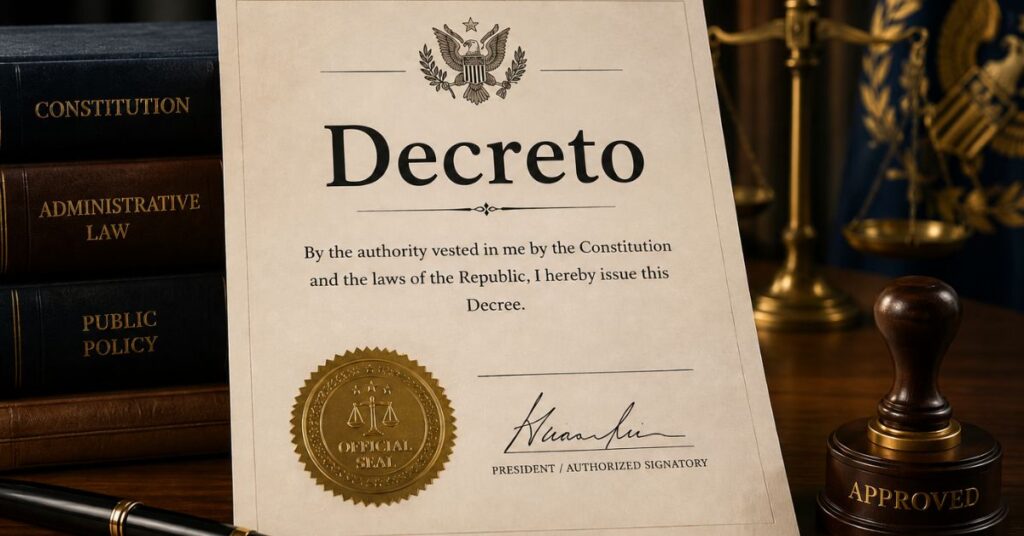

The name “Decreto” Supremo 160 comes up very often when legal discussions about Latin America are held, however this decree doesn’t always signify the same thing; usually it refers to a variety of government regulations depending on the country, the year they were enacted and ministry that issued them which makes reading about them very confusing for the ones who wants to know what it refers to exactly.
One of the most well-known uses of the Decreto Supremo 160 is the Chilean one which is most certainly associated with regulations for combustible liquids; in this case, the law deals with technical, operation and security standards applied to systems related to fuel storage, transport, and service stations.
But, there is nothing to imply this rule has to mean the same in countries such as Peru and Bolivia where the same regulation number is attributed to completely different regulations such as decisions related to governmental budget, administrative matters or the functioning of public institutions.
So, what exactly is Decreto Supremo 160, and why is it so important?
A Decreto Supremo 160 is essentially a legal designation applied by governments to various types of regulations throughout Latin America. More specifically, a ‘decreto supremo’ in a broad sense denotes high-ranking regulations issued by the executive branch of a country to deal with specific administrative, technical or security matters. However, the number 160 isn’t unique across countries, leading to confusion as the decrees may bear the same numbers, despite holding entirely different meanings.
Within Chile, a Decreto Supremo 160 is most commonly known for its connection to combustible liquid regulations. This version pertains directly to all aspects of fuel infrastructure- storage facilities, transport, service stations- that must be operated and constructed according to stringent public safety regulations. This particular decree has been pivotal for various sectors involved with hazardous materials, specifically in transport, energy, and industry.
This regulation is highly significant, owing to its direct role in safety standards; far from being merely a legal document, this regulation provides the legal and technical framework in which industrial businesses in the sector operate, thus facilitating compliance with national security and operational standards and mitigating potentially significant operational risks.
Also Read: The Hidden Impact of ksözcü on Modern Communication
History and legislation in Chile and other countries
In Chile, Decreto Supremo 160 emerged as a crucial component of a much wider reform of industrial safety regulations. In the years that followed, industrial development combined with a rapid expansion of cities in Chile created a necessity for governments to exercise greater control over combustible materials. Consequently, governments began developing more detailed and technical regulatory systems.
Within Chile’s legal structure, regulations like decrees issued through executive power require the expertise of technical agencies for enforceability and interpretation, thus integrating legal norms and engineering practices. As a result, this has led to a well-established technical regulatory framework that bolsters industrial safety. Outside of Chile, the numbering is frequently repurposed. Peru and Bolivia use decreto supremo 160 to denote different regulations pertaining to government budgets, institutional changes or even public administrative processes; these vary greatly depending on each nation.
Safety standards for flammable liquids based on DS 160 Chile
The Chilean Decreto Supremo 160 is intrinsically linked to security measures for combustible liquids. This law defines how fuels such as petrol, diesel, and others hydrocarbons can be transported, stored, and distributed according to rigid safety standards. The rules focus on reducing risks related to fires, leakages and pollution of environment as a whole. The decree states strict technical parameters
Here is an overview of the scope of Chilean regulation simplified.
| Area of Regulation | Main Purpose | Example Requirement |
| Storage Systems | Prevent leaks and explosions | Double-wall tank structures |
| Transport Systems | Ensure safe fuel movement | Certified tanker vehicles |
| Service Stations | Protect public and workers | Fire suppression systems |
| Pipelines | Maintain structural safety | Pressure monitoring systems |
These safety measures are required to minimize any hazard associated with the storage and handling of combustible materials. The aim is not just to prevent accidents in the immediate sense, but to achieve this in the long term for environmental safety purposes too.
Institutional controls and compliance.
The supervision and enforcement of decree supreme 160 in Chile are executed by the Superintendencia de Electricidad y Combustibles. This institution is empowered with the tasks of monitoring adherence, performing inspections on sites, and confirming the fulfillment of all technical criteria within the fuels sector.
Enterprises in the fuels sector are regularly submitted to inspections and certification. These procedures verify that the installations are safe for use in the future and meet all specified regulatory requirements. Noncompliance could lead to sanctions, the closure of establishments, or even legal penalties.
The system of compliance favors preventive safety practices rather than reactive measures. Rather than awaiting accidents to occur, the system mandates continuous monitoring, maintenance, and certification. In this manner, it enhances overall industrial safety.
Also Read: Severna Dakota: Incredible Facts That Will Wow You
International Ambiguity: Peru and Bolivia Variations Explained
One of the most confusing aspects of decree supreme 160 is its frequent usage in various countries in varied forms. The number in Peru, for instance, may designate budget allocations, administrative reforms, or institutional reconfigurations, in no way linked to fuel safety regulations in Chile.
The number in Bolivia also represents diverse decrees of government management or procurement. In most cases, such decrees are particular to specific years and policy objectives and bears no similarity to the combustible liquids regulation in Chile.
These examples illustrate why the universal interpretation of the number cannot be presupposed. The same number can designate multiple legal actions depending on the nation’s governance framework. Country and year are key to precise interpretation.
Conclusion
Although decree supreme 160 is widely utilized throughout Latin America as a generic number, its most significant and technical application can be attributed to Chile’s combustible liquids safety regulation system. In that specific case, it is crucial in guaranteeing the safe usage of combustibles, protecting both lives and infrastructure from industrial hazards.
Concurrently, the identical number applies to a wide array of distinct legal actions in other nations such as Peru and Bolivia, each with its own unique governmental and administrative purpose. This dual usage emphasizes the importance of context when approaching legal texts.
Ultimately, the interpretation of decree supreme 160 involves far more than simply referring to the number itself. One must have an understanding of specific national legal systems, supervisory bodies, and the particular intent behind each decree. In Chile, it serves as a vital component of industrial safety, whereas in other nations it designates purely administrative tasks.
FAQs
1. What is it Decreto Supremo 160 on chile?
It is a decree on the safe usage of combustible liquids, the storage, the transport, and working conditions in fuel plants, and also of fuels facilities operations
2. Is Decreto Supremo 160 the same in all countries?
No, the number of the decree repeated in various countries with different reasons or affairs not related at all, the number can be reused by a government for a law of any type given the year the country and government applied the decree
3. Who executes this Decreto Supremo 160 on chile?
The Superintendencia de Electricidad y Combustibles.
4. Why is it so important?
This decree is crucial as it prevents accidents and leaks of fuels that can cause environmental damage or casualties in different facilities that use combustible liquids.
5. Does the Decreto Supremo 160 have anything to do with fuels in all countries?
Only in chile it is related with the use of fuels