
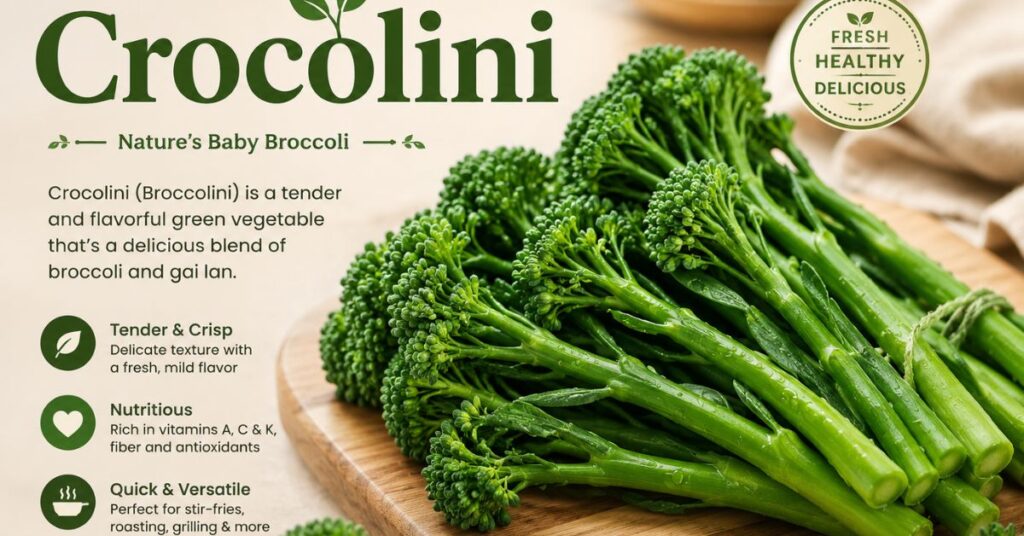

The word ‘Crocolini’ is one of those words that often pop up on the internet, mostly in relation to Broccolini, an all-around delicious vegetable which has become very popular worldwide due to its sweet flavor and elegance. Although ‘Crocolini’ might appear to sound unique or like it could be some different kind of food, the truth is it only refers to this same green vegetable you have all grown to know and love. Confusion usually arises due to the inability of users to spell correctly, how you hear it and pronunciation.
The significance of understanding this name confusion lies in understanding how the digital world influences how we perceive information about food, and a misplaced letter can make a very commonly searched phrase become some alien sounding object or food. Crocolini, in this case, refers to nothing new in terms of a vegetable.
Essentially, this food product is a hybrid plant developed by crossing ordinary broccoli with gai lan. Both of these vegetables belong to the species of plant called Brassica oleracea and also contains within it vegetables like cabbage and kale. This is why it bears the traits of more than one type of vegetable but still offers its own unique flair.
The birth and evolution of Broccolini.
It took a while, and a lot of genetic manipulation for this vegetable to be developed in a way that combined its characteristics to make it what it is today. In a way it was born of two vegetables ( Broccoli and gai lan) by combining their most likable qualities to give the modern consumer a vegetable that is not only pleasing on the eye, but is also tasty enough to suit even the fussiest taste bud, a great example of how agricultural science continues to evolve vegetables for us.
Its introduction into the rest of the world was a real game-changer when it came to green vegetables. A lot of countries fell in love with this green, beautiful vegetable which then spread around the world at incredible speed becoming popular amongst all types of cuisine and cultures. Many people know it by its many different names; “tenderstem broccoli” and “Bimi” for example are popular in different regions and countries.
In the US the name “Broccolini” is actually a registered trademark by Mann Packing, this really made the green vegetable more popular, which in turn helped it enter other markets, in spite of this however the vegetable itself can be grown and is produced by many around the world.
Physical Features and growth rates
One of the reasons why Crocolini or Broccolini has such a sophisticated name is down to its appearance, not as a typical thick vegetable like normal broccoli, with fat thick stalks and little florets, Broccolini has long, thin stems topped with smaller, tender florets, giving it an elegant and more appealing appearance which suits it perfectly in modern, clean-lined cooking styles.
It grows on average to a height of 80cm, with a stem length of between 15cm and 30cm and the stem of Broccolini is smooth, lacks hair and is very green. Because the stems are also completely edible along with the florets, you’re guaranteed more nourishment.
It is grown as an annual and bi-annual herbaceous plant in temperate climates and will grow quite easily alongside other Brassica’s. Farmers and keen home gardeners will see it grow to a good height quite quickly as it matures fast and produces consistent crops.
What it offers nutritionally and its benefits.
As many green vegetables are so beneficial to the body, it’s no surprise that Broccolini is as nutritional as it is. The most common nutrients people associate with leafy greens are vitamins and minerals such as Vitamin C, Vitamin A, as well as plenty of fiber. It’s packed with these and that’s a good reason for it becoming quite popular.
However, it’s not just about simple nourishment; it’s also a powerful food containing numerous antioxidants which will help fight against oxidants within the body, supporting your immune system as well as potentially helping prevent chronic illnesses. Simply eating a meal cooked with Broccolini can aid you greatly without compromising on flavor.
Another benefit is that due to its high levels of vitamins and minerals and the lack of calories and fat contained within, Broccolini makes an ideal vegetable to include in any meal for a diet that is focused on healthy eating.
Gastronomy & preparation.
Due to its versatility the humble Crocolini (or Broccolini as it should really be known) is able to compliment a variety of dishes beautifully, the long, slender stems and the delicate florets are perfect whether cooked, grilled or fried. Many people prefer it when it is lightly sautéed with garlic and olive oil, lemon juice can be squeezed over it at the end for some added zing and its elegance means it is perfect for making a simple meal look like it belongs in a restaurant.
When lightly cooked it maintains a little crunch which provides contrast in most dishes. If you’re looking for something different then steamed or roasted it will remain moist and very tasty while if it is simply cut and eaten raw as part of a salad then the texture becomes similar to that of very tender normal broccoli which requires little if any preparation.
Crocolini versus Broccoli: Important distinction
Though you can certainly see it relates to Broccoli, Crocolini (Broccolini) is a very different kind of vegetable and there are many ways it separates itself from ordinary Broccoli. Firstly and perhaps the most obvious difference, the appearance is much more refined with its long, smooth stems, and its much smaller, more intricate florets give it a much neater look, whereas the head of broccoli can appear rather dense and chunky.
Taste is the next and possibly most distinguishing difference of these two vegetables. Broccolini has a much sweeter flavor that’s also a little less bitter than that of a regular Broccoli, allowing for a wider range of recipes to be cooked as it is much more complementary and has a less assertive taste.
Here’s a breakdown so you know what’s being compared:
| Feature | Broccolini (Crocolini) | Broccoli |
| Structure | Long stems, small florets | Thick stalk, dense head |
| Taste | Mild and slightly sweet | Stronger, slightly bitter |
| Cooking Time | Shorter | Longer |
| Texture | Tender | Firm |
| Appearance | Elegant and slender | Compact and bulky |
It is these factors which have allowed Broccolini to stand on its own within today’s cooking culture and provide a tasty and easy alternative to broccoli.
Crocolini-the name significance in our lives today
While Crocolini is simply a misspelling, it has generated quite a buzz due to its increasing presence on search engines and online discussions. This is a direct reflection of how people today discover and acquire information about food. The smallest of spelling mistakes can lead to entirely new threads of conversations, even if they refer to the same entity.
This spelling variation also emphasizes how global communication influences language. As diverse cultures interact, the way they interpret and spell certain words will differ, ultimately creating new vernaculars. Here, Crocolini is an example of how our digital landscape is shaping our everyday terminology.
Understanding this connection will only aid in closing the gap between confusion and understanding. Knowing that both Crocolini and Broccolini refer to the same vegetable allows readers to more easily navigate and avoid pointless arguments. This realization will also bring clarity to food labeling practices and vegetable categorization.
Conclusion
Crocolini might sound like a new and unknown variety, but the reality is that it refers to the widely recognized and highly appreciated Broccolini. This one spelling mistake has piqued curiosity and opened up conversations about how simple discrepancies can garner significant attention. As its origins, characteristics, and value are explored, it’s evident that the vegetable itself is nutrient-rich and incredibly versatile.
The journey from confusion to comprehension not only reveals the identity of a vegetable but also illustrates how our perception of food is influenced by language and how easily information can spread in the modern era. Whether it’s in a recipe, on the produce aisle or appearing in a Google search, the term Crocolini serves as a reminder to pay attention to detail.
Ultimately, it’s what the vegetable can do for us in the kitchen that matters most. Mild, nutritious, and adaptable to a wide array of culinary preparations, Broccolini continues to remain a beloved favorite. Its relation to Crocolini is just one part of its story.
FAQs
1. Is Crocolini different from Broccolini?
No, Crocolini is a simple misspelling of Broccolini and they refer to the same vegetable.
2. What is Broccolini made from?
Broccolini is a hybrid of traditional broccoli and gai lan, which accounts for its distinct features.
3. Are the stems of Broccolini edible?
Yes, Broccolini’s stems are tender and entirely edible, which means the whole vegetable is utilized.
4. Does Broccolini taste like broccoli?
Broccolini has a slightly milder and sweeter flavor than its traditional counterpart.
5. How is Broccolini best cooked?
Broccolini can be prepared in numerous ways including sautéed, steamed, roasted, or grilled.